
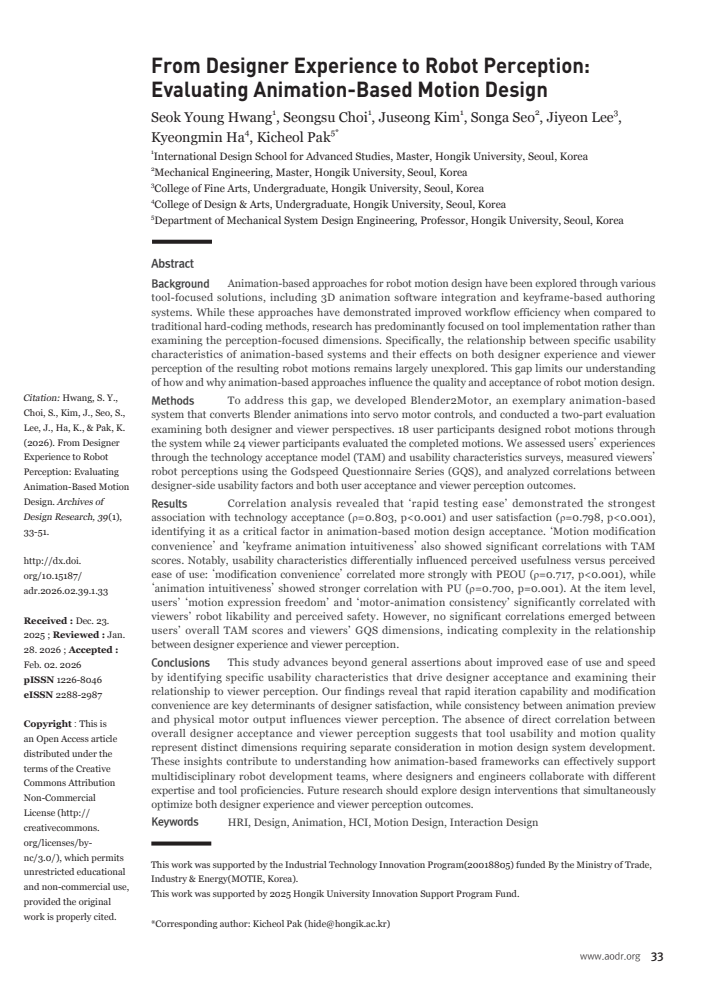
This study aims to quantitatively examine how animation-based robot motion design influences designers’ technology acceptance and how it relates to observers’ perceptions of the robot. To this end, the authors developed an animation-to-actuation workflow (Blender2Motor) that converts keyframe animations created in Blender into servo-motor control for real robot playback. The pipeline covers bone-to-motor mapping, Bézier-curve timing control via the Graph Editor, motor parameter settings, exporting keyframe data, executing motion on the robot, and visualizing discrepancies by comparing target positions with actual motor positions.
The evaluation was conducted with two groups: a user group composed of designers and engineers who directly used the system, and a viewer group who only watched instructional material and demonstrations. The user group was assessed using the Technology Acceptance Model (TAM), including perceived usefulness and perceived ease of use, along with animation-based usability attributes and overall satisfaction. The viewer group evaluated robot perception using the Godspeed Questionnaire Series, focusing on anthropomorphism, animacy, likeability, perceived intelligence, and perceived safety.
The analysis showed that the strongest driver of designers’ acceptance was the ease of rapid iterative testing, followed by the convenience of motion modification and fine-tuning, and the intuitiveness of the keyframe-based workflow. Importantly, these factors appeared to operate through different acceptance pathways: modification convenience was more tightly linked to perceived ease of use, whereas keyframe intuitiveness was more strongly associated with perceived usefulness. This suggests that editability primarily reduces interaction complexity, while the intuitiveness of the animation authoring paradigm reinforces the sense of practical value.
In contrast, the usability attributes did not exhibit strong direct relationships with the five Godspeed dimensions at the aggregate level. However, item-level results indicated meaningful links between motion expression freedom and several likeability-related items, as well as parts of safety-related impressions. Likewise, motor–animation match was associated with likeability items and also connected to perceived animacy (e.g., the dead–alive impression). These patterns imply that observers’ impressions may depend less on whether the tool feels convenient to creators and more on whether the resulting motion is rendered convincingly, particularly through high transfer fidelity and expressive capacity.
Notably, no significant correlation was found between the user group’s overall TAM scores and the viewer group’s overall Godspeed scores, indicating that improvements in creators’ experience do not automatically translate into improved observer perception. Additional analyses suggested that hands-on experience substantially shapes perceived ease of use, meaning that observation-only exposure may be insufficient for forming accurate judgments about controllability and workflow clarity. The authors also discuss the possibility that prior experience with 3D animation tools can shift evaluation criteria and motion authoring tendencies, potentially affecting how social and affective qualities are expressed in the resulting motions.
Qualitative feedback reinforced the advantages of rapid testing, intuitive editing, high expressive freedom, and immediate verification through Blender-based previews. At the same time, respondents highlighted limitations such as the lack of a fully code-free environment, Blender’s learning curve, incomplete modeling of physical constraints (e.g., torque and inertia), and potential overhead for very simple motions. Overall, the study concludes that animation-based approaches can accelerate iteration and strengthen designer acceptance in multidisciplinary robot development, while emphasizing that improving observer perception requires explicit attention to outcome-critical factors—especially animation–actuation alignment and expressive freedom—rather than assuming they will improve as a byproduct of better tooling.
댓글 0