
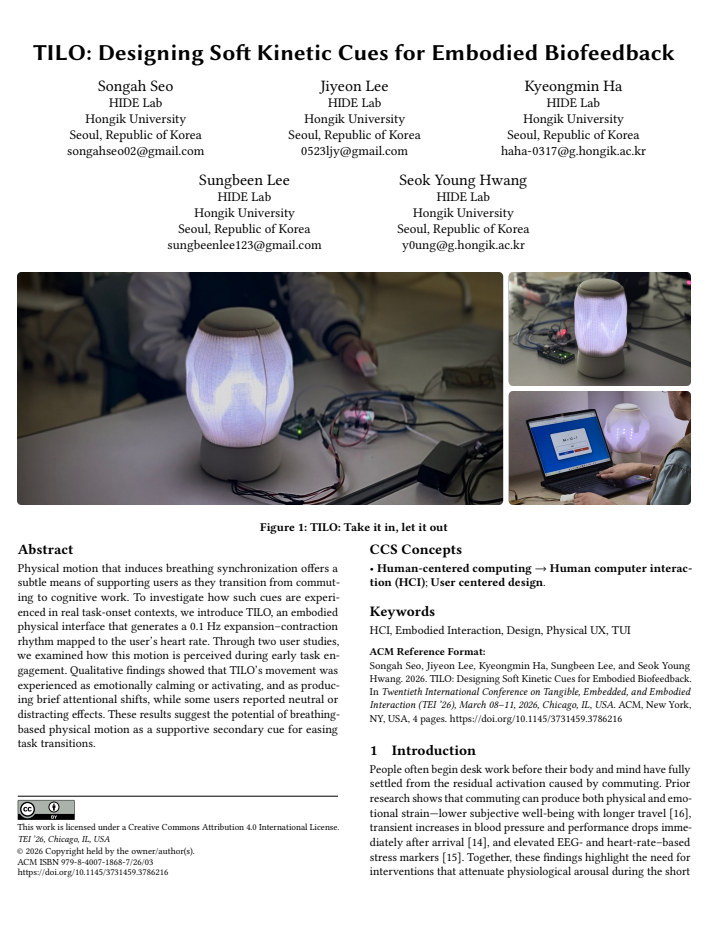
This study investigates the moments when people must rapidly shift into cognitive work while residual physiological and emotional arousal remains—such as immediately after commuting—and asks how gentle, breathing-like physical motion that encourages respiratory entrainment can support task transitions in everyday contexts. Grounded in prior evidence that slow breathing can reduce heart rate, increase heart-rate variability, alleviate stress, and benefit executive function and working memory, the work extends “external rhythmic cues” for breath regulation beyond purely visual or haptic signals to a physically transforming interface whose form actually expands and contracts. To this end, the authors propose TILO (Take It in, Let It out), a lighting-based biofeedback prototype designed to generate a 0.1 Hz expansion–contraction rhythm aligned with the user’s heart signal, functioning as a soft cue that naturally slows breathing.
TILO’s form and material choices were informed by impression factors relevant to affect regulation, adopting a curvature-driven, gentle silhouette and an elastic fabric that stretches multi-directionally while providing a stable tactile feel, so that users perceive a “soft volumetric change.” Mechanically, the device was designed to appear as if it expands and contracts in volume through coordinated rotational motion across the x, y, and z axes. The 3D-printed structure consists of a base, upper and lower rotation modules, an upper body, and an internal fabric-tension module; when the motor actuates, linked flaps unfold, the outer skin expands, and the upper body rises to create an omnidirectional “breathing” transformation. The motion profile reflects the temporal asymmetry of human respiration by setting an inhale–exhale ratio of 1:1.2 and implementing a non-linear trajectory—rapid rise with a gentle plateau for inhalation, followed by a sharper drop with gradual damping for exhalation—using Bézier-curve animation. This gesture was realized as a 10-second loop (0.1 Hz) with a maximum expansion angle of 65°. For implementation, keyframe animation data were exported as time–angle pairs in JSON, then converted into a mathematical waveform approximated with a 5th-order Fourier series for real-time control. Using an adult resting heart-rate range of 60–100 bpm as a reference, amplitude and frequency were adaptively mapped to heart rate so that higher heart rates would lead the system to cue slower, deeper breathing. Overall, the pipeline comprises biosignal acquisition, heart-rate computation, parameter mapping, and playback of the breath-guidance motion, thereby providing a physical biofeedback cue responsive to changes in the user’s state.
The user evaluation was conducted in two rounds. The first test focused on checking technical completeness and overall user experience to identify improvements. Participants generally received the expansion–contraction motion positively, and some reported that their breathing began to align with the device’s rhythm; however, others noted that mechanical noise during actuation became more salient than the motion itself and disrupted relaxation, motivating structural and design refinements. The second test used the improved prototype to examine how TILO affects users at the onset of cognitive work. Participants performed a light walk for three minutes to simulate commuting strain, then completed a five-minute arithmetic task under both a no-TILO condition (A) and a TILO condition (B) in a within-subject design. In this stage, many participants described the heart-responsive motion as visually engaging and reported that it influenced their breath control and calming in practice. They also tended to interpret the device’s movement explicitly as “breathing,” describing experiences such as “it feels like it regulates my breathing,” “it feels synchronized with my heartbeat,” and “because the light breathes slowly, I naturally breathe more slowly too,” although the degree of entrainment varied across individuals.
Regarding effects during the cognitive task, some participants reported reduced anxiety, emotional relaxation, and brief attentional shifts that helped them organize thoughts and regain focus. Others acknowledged noticing the device but felt it did not help task performance, and a few stated that the motion distracted them and interfered with concentration. To explore the relationship between subjective reports and performance, the authors computed task outcomes as the product of accuracy and the number of solved items and compared conditions A and B. They observed a pattern in which some participants who reported feeling encouraged, experiencing respiratory entrainment, sensing calming effects, or feeling refreshed also showed improved performance, suggesting that breathing-oriented physical biofeedback may support task outcomes through affect regulation and cognitive control. Overall, the study suggests that soft, breathing-like physical motion synchronized to heart-related signals can be perceived in multiple ways—emotional calming, activation, or brief attentional reframing—and may function as a secondary supportive cue that smooths the transition from commuting to cognitive work. At the same time, the presence of neutral or even negative reports indicates that such motion cues can be sensitive to user state, task immersion, and environmental conditions. Finally, the authors note limitations of relying on a direct, attached heart-rate sensor in the current prototype and propose future work that integrates wearable biosensing for more natural everyday use, expands sample sizes and user diversity for stronger quantitative validation, and further refines the role and design principles of TILO within breathing-based interaction strategies.
댓글 0