
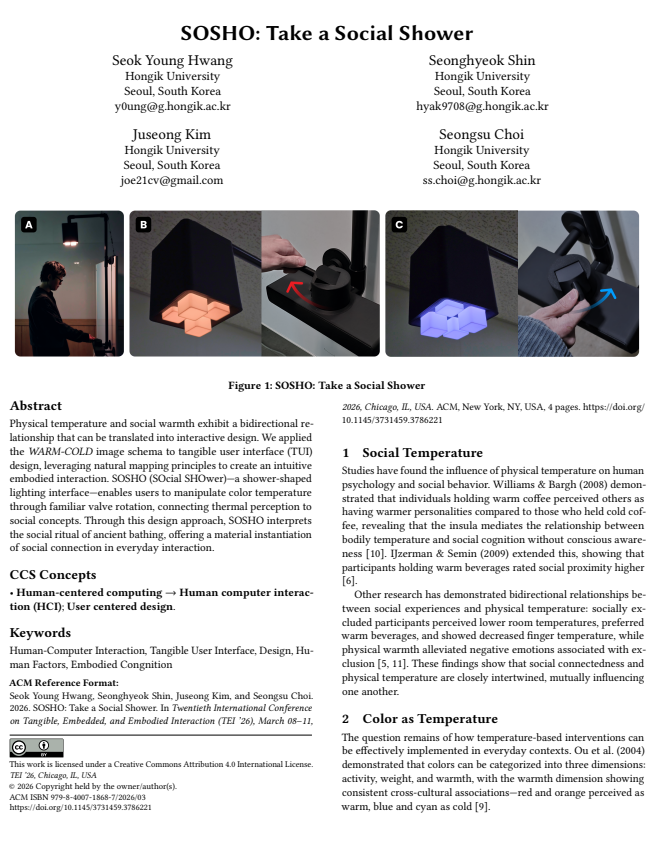
This study aims to explore the design potential of a tangible interaction that enables people to intuitively embody the concept of “warmth–closeness” in everyday life, drawing on psychological and cognitive-science findings that physical warmth and social warmth mutually influence one another. The authors interpret the bidirectional relationship—where physical temperature can shape impressions of others and perceived social distance, and social exclusion or isolation can be experienced as “coldness”—as a usable design resource. Rather than directly controlling real temperature, they leverage the fact that the “color temperature” of light is consistently perceived as warm or cool, and propose an interface that metaphorically evokes social warmth through controllable lighting.
A core design principle is the use of image schemas and natural mapping, particularly the WARM–COLD schema and its extension to social intimacy. Based on this perspective, the authors seek to create a tangible user interface that allows meaning to be understood “through the body,” with minimal need for instruction. To realize this idea, they develop SOSHO (SOcial SHOwer), a showerhead-shaped lighting interface that translates a familiar shower interaction into a light-based experience. In SOSHO, the well-known relationship between turning a shower valve and getting warmer or colder water is mapped to adjusting the color temperature of light.
SOSHO is composed of an input module and an output module. The input module is a two-axis rotational handle that captures continuous rotation values, while the output module combines LEDs and servo-motor units so that the user’s manipulation is immediately expressed through changes in light properties and water-droplet-like visual effects. The first axis corresponds to temperature control: handle rotation is mapped to LED RGB adjustment, producing a warm (reddish) impression at lower color temperatures and a cool (bluish) impression at higher color temperatures. The second axis corresponds to water pressure control and implements a “dripping water” visual metaphor: as the handle value increases, multiple output elements move more strongly and irregularly, the illuminated area expands, and overall brightness rises, enabling users to feel—both visually and physically—that “turning it up” results in “more pouring out.” The handle itself uses a high gear ratio to reduce sagging and to behave like a damper, providing tactile resistance reminiscent of a real shower valve and strengthening the persuasiveness of the manipulation.
A user study investigated whether SOSHO can facilitate the intended meaning linkage between “color-temperature manipulation” and “social warmth.” Participants were assigned to either a warm-light-only condition or a cool-light-only condition. After using the device, participants were instructed to think of a specific acquaintance, then completed measures including the Inclusion of Other in the Self (IOS) scale and usability-related questionnaires. Finally, they performed a choice task in which they decided whether to allocate a reward to themselves or to the person they had just recalled. Data from 40 valid participants (aged 19–30) were analyzed. In the reward-allocation task, the warm condition showed a higher rate of choosing to give the reward to the recalled person than the cool condition, and this difference was statistically meaningful. However, no significant condition differences were found on other measures, including the IOS score, meaning that the observed difference in reward choice cannot fully rule out the influence of chance or uncontrolled factors. Still, the general tendency for the warm condition to show higher mean values across many items suggests that color-temperature-based interaction may have the potential to tilt judgments related to social warmth in a consistent direction.
The study contributes in three main ways. First, it offers a concrete design strategy that connects an abstract concept—social warmth—to tangible manipulation and the chain of meaning activation enabled by lighting color temperature, thereby translating psychological insights into everyday interactive experience. Second, it reframes showering not merely as a hygienic act but as a socially meaningful scene, arguing that communal bathing once carried a sense of togetherness but has increasingly become a private routine due to changes in technology and infrastructure; within this framing, the work explores how everyday rituals might be reconfigured into more social and ceremonial experiences. Third, by acknowledging that the results are not decisively conclusive, the study highlights the need for more rigorous follow-up validation that goes beyond a single metric and more carefully controls and expands variables such as the strength of meaning activation, contextual factors (e.g., the type of person recalled and current mood), usage duration, and interaction patterns. Overall, through SOSHO the study integrates theory (the warmth–sociality link), implementation (image-schema-driven tangible lighting), and experience (reconstructing the social meaning of showering) into a coherent flow, proposing the design possibility that an ordinary daily act can be transformed into an interaction ritual that resonates with intimacy and social connection.
댓글 0