
통합 검색
통합 검색
- 작성자 HIDE
- 조회수 230
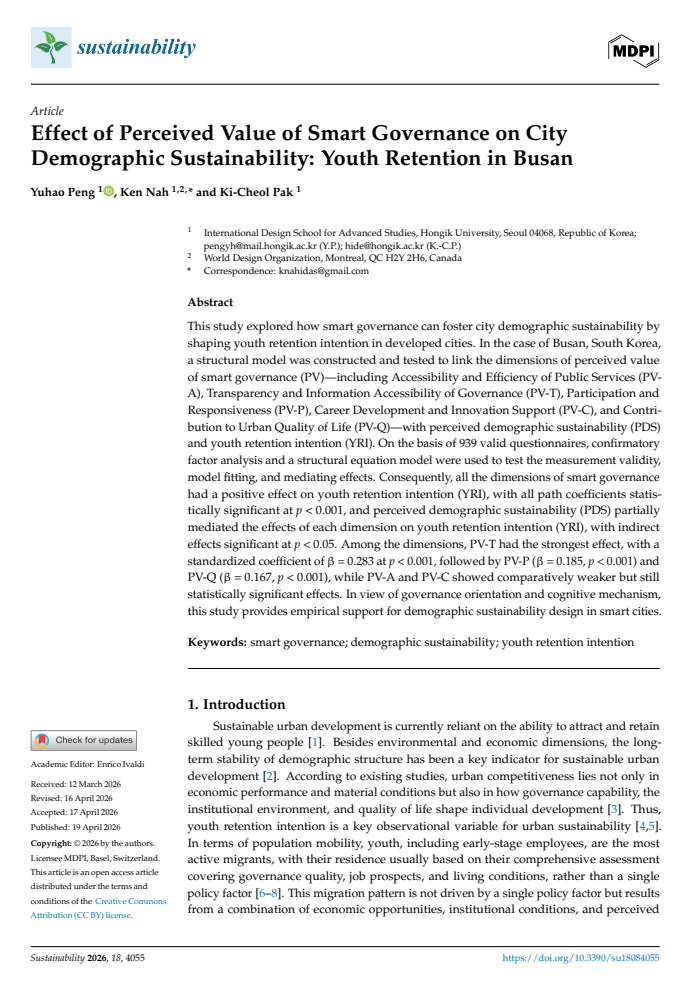
Topic: Effect of Perceived Value of Smart Governance on City Demographic Sustainability: Youth Retention in Busan
This study investigates how the perceived value of smart governance influences city demographic sustainability and youth retention intention, focusing on Busan, South Korea. Busan, despite being the second-largest city and a major port city in Korea, has experienced a continuous outflow of young people to the Seoul metropolitan area. This demographic imbalance raises concerns about the city’s long-term social vitality, innovation capacity, and sustainable development. Against this background, the study argues that smart city strategies should not be evaluated only by technological infrastructure or administrative efficiency, but also by how young residents perceive their value in relation to daily life, career opportunities, institutional trust, and future urban prospects.
The research constructs a structural model linking five dimensions of the perceived value of smart governance to perceived demographic sustainability and youth retention intention. The five dimensions are: accessibility and efficiency of public services, transparency and information accessibility, participation and responsiveness, career development and innovation support, and contribution to urban quality of life. Perceived demographic sustainability refers to young people’s subjective judgment about whether the city can maintain demographic vitality, attract and retain young residents, and sustain a balanced population structure in the future. Youth retention intention refers to the willingness of young people to continue living, working, and building their future in Busan.
The study collected 939 valid responses from young residents in Busan, mainly aged 20 to 40 and in the early stages of their careers. Using SPSS and AMOS, the authors conducted reliability analysis, exploratory factor analysis, confirmatory factor analysis, and structural equation modeling. The measurement model showed strong reliability and validity, with all major constructs meeting accepted statistical criteria. The structural model also demonstrated a good fit, indicating that the proposed relationships among smart governance, perceived demographic sustainability, and youth retention intention were statistically reliable.
The findings show that all five dimensions of smart governance have significant positive effects on youth retention intention. Among them, transparency and information accessibility had the strongest influence. This suggests that young people are particularly sensitive to whether they can clearly understand government information, urban development plans, and policy directions. Rather than responding only to convenience or digital service efficiency, young people appear to value a transparent and predictable governance environment that allows them to trust the city’s future development path.
The study also confirms that perceived demographic sustainability partially mediates the relationship between smart governance and youth retention intention. In other words, when young people perceive smart governance positively, they are more likely to believe that the city has a sustainable demographic future. This belief, in turn, strengthens their intention to remain in the city. The strongest indirect effect was again found in transparency and information accessibility, indicating that visible, credible, and understandable governance plays a key role in shaping young people’s confidence in the city’s future.
The theoretical contribution of this study lies in shifting the discussion of smart cities from a technology-centered perspective to a governance- and perception-centered perspective. It demonstrates that smart governance can contribute to social and demographic sustainability not simply by improving service delivery, but by shaping citizens’ expectations, institutional trust, and long-term confidence in the urban future. The study also expands the concept of urban sustainability by emphasizing youth retention and demographic vitality as important dimensions of sustainable urban development.
From a policy perspective, the findings suggest that cities facing youth outflow should move beyond technology-driven smart city projects and focus more on transparent, participatory, and responsive governance systems. For Busan and similar developed cities, improving digital platforms and public services is important, but it may not be sufficient. Local governments need to communicate long-term development strategies clearly, provide accessible policy information, create meaningful channels for youth participation, and connect smart governance initiatives with career development and quality-of-life improvements.
The study has several limitations. The sample includes a relatively high proportion of highly educated respondents, which may affect the generalizability of the findings. The use of non-probability sampling and cross-sectional survey data also limits causal interpretation. In addition, the research focuses only on Busan, so further comparative studies across different cities and countries are needed. Nevertheless, the study provides meaningful empirical evidence that smart governance can support demographic sustainability by strengthening young people’s confidence in the future of the city and their intention to remain there.
댓글 0